Getting to know Jesus · Lesson 4
Abraham. The Faith God Counted as Righteousness, and the Ram God Provided
Listen to the lesson in Thai
Audio loads when you press play.
Read the passage first
Read Genesis 12:1–3 first. Only three verses, but very important. Then read Genesis 15:1–6. After that read Genesis 22:1–19 slowly, the whole passage.
If chapter 22 leaves you uneasy about what God commands Abraham, do not hurry past that feeling. We will talk about it in the lesson.
What happens in this passage
God calls one man (12:1 to 3). After the flood, people turn their backs on God again (the story of the tower of Babel in chapter 11). But instead of judging the whole world a second time, God chooses to start over with a single person: a man named Abraham (at this point still called Abram), seventy-five years old, childless, living in a city that worshipped many gods. God tells him to leave his homeland and his relatives and go to a land God will show him, and makes him three promises: that he will become a great nation, that God will bless him, and that through him every family on earth will be blessed.
That last promise is the most important. Ever since Genesis 3:15 God had promised to send someone from the offspring of the woman. Now the promise narrows to one family. The one who will put everything right will be born in Abraham's line, and the blessing is not for one nation only, but for every nation, including the Thai people.
Faith that God counted (15:1 to 6). Years pass. Abraham grows older and older, and his wife Sarah still has no child. He begins to doubt. One night God takes him outside, tells him to look at the stars, and says his descendants will be that many. Abraham believes. Then comes a sentence in verse 6 that the New Testament quotes again and again: Abraham believed God, and God counted that faith to him as righteousness.
Stop here for a moment. That night Abraham had not done anything yet. He had not offered anything, had not performed any special good deed. He simply trusted what God said, and God regarded him as right before him. Paul, who wrote many of the New Testament books, uses this verse to explain how a person is made right with God. The answer is by faith, not by storing up good works (Romans 4:1–5).
The hardest test (22:1 to 10). At last Isaac, the son Abraham had waited for his whole life, is born when Abraham is a hundred years old. Then one day God tells Abraham to take his only son, whom he loves, up a mountain God will show him, and offer him there as a sacrifice.
If that makes you flinch, that is the right reaction. The Bible means for us to feel its weight. But notice some things. First, the very first verse tells us in advance that this is a test. Second, the God of the Bible plainly forbids human sacrifice. The nations around Israel practiced it, and God says he hates it (Deuteronomy 12:31). Third, on the way up the mountain Isaac asks where the lamb is, and Abraham answers that God will provide the lamb himself (verses 7 to 8). The book of Hebrews says Abraham believed that even if his son died, God could bring him back to life (Hebrews 11:17–19). His faith was not resignation. It was trust that the God who made the promise would not break it.
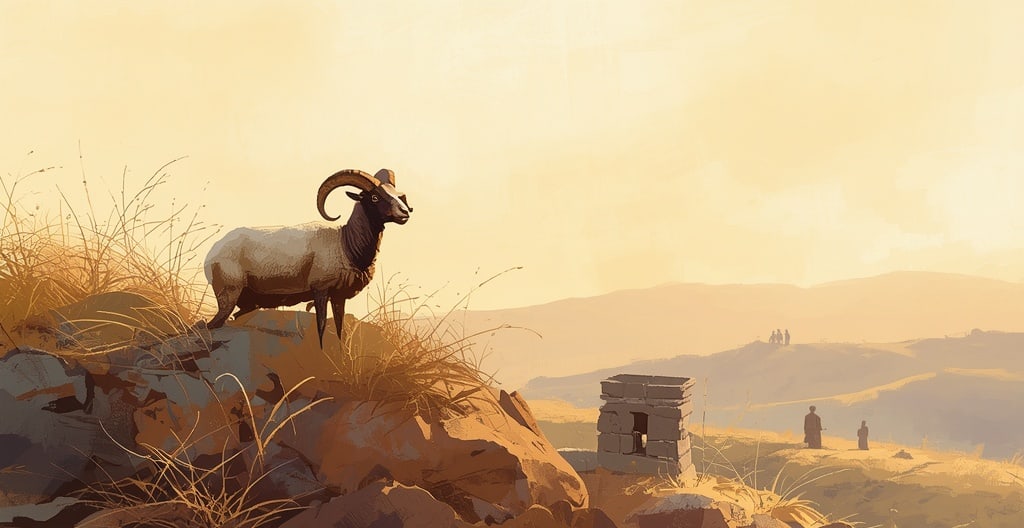
The ram God provided (22:11 to 19). As Abraham raises the knife, God calls him to stop, and says that now he knows Abraham truly trusts him. Abraham turns and sees a ram caught in a thicket, and he offers the ram in place of his son. Isaac walks down the mountain beside his father because another life died in his place. Abraham names the place with a name that means "the LORD will provide" (verse 14; your Bible may show the Hebrew name with its meaning in a footnote at the bottom of the page). And God confirms the promise once more: every nation will be blessed through his offspring.
How this points to Jesus
- A father, an only son, and a mountain. The picture of a father taking his only, beloved son up a mountain to offer him is a picture in advance of what God the Father would actually do about two thousand years later. The best-known verse in the Bible says that God so loved the world that he gave his only Son (John 3:16). But here is the difference. On Abraham's mountain there was a voice calling him to stop. At the cross there was no voice calling a halt. God really gave his Son.
- The ram that died instead. Isaac lived because a ram died in his place. This is the picture behind the word instead, which is the heart of what Jesus did. Jesus did not die for his own sin, because he had none. He died in our place, like the ram in the thicket, which Abraham did not find on his own but God provided.
- The offspring through whom every nation is blessed. Paul points out that the word "offspring" in this promise finally means one person: Christ (Galatians 3:16). Jesus was born in Abraham's line (Matthew 1:1 opens with exactly that sentence), and through him Abraham's blessing reaches every nation, including you, reading this now.
- Right with God by faith. What happened to Abraham on the night he looked at the stars is what happens to everyone who trusts Jesus. God counts us righteous, not because we have done enough good, but because we trust him (Romans 4:23–25).
Words to know
The word righteousness (ความชอบธรรม) sounds like legal language. Its plain meaning is being right before God, with nothing held against you. In Thai thinking we might assume you have to make enough merit to outweigh your wrongs before you count as right. But the Bible says God counts it to you, the way a person gives a gift, not the way an employer pays wages.
The word ประทาน is royal register for "give." When you meet it in John 3:16, where God ประทาน his Son, read it as "God gave his Son." And พระบุตร means "Son." It is the word the Bible uses for Jesus as the Son of God the Father. It does not mean God has a wife and children the way humans do. It means the closest possible relationship and oneness. We will talk about this more in lesson 10.
The word blessing (พระพร) in the Bible is not good luck requested from a sacred object. It is the good that God intends to give, above all being brought back into relationship with him.
Reflect
- God told Abraham to set out before telling him where the destination was. Have you ever had to trust someone without seeing the whole picture first?
- Genesis 15:6 says God counted faith as righteousness. If that is true, how does it change the way you think about doing good?
- Picture Isaac walking down the mountain beside his father because a ram died in his place. How do you think he looked at that ram? And how would you feel if someone did that for you?
Pray
"God, Abraham trusted you before he could see anything at all. I want to trust you like that. Thank you that you are the one who provides, and that I do not have to find it myself. Help me understand more of what it means that Jesus died in my place. Amen."