Getting to know Jesus · Lesson 3
Cain, Abel, and Noah. The Sacrifice God Accepted, and Rescue Through a Single Ark
Listen to the lesson in Thai
Audio loads when you press play.
Read the passage first
Read Genesis 4:1–16, the story of Cain and Abel, first. Then read Genesis 6:5–22 and 7:17–23, the flood. Finish with 8:20–22 and 9:8–17.
The flood section has a lot of detail about the size of the ark and the number of days. You do not need to remember any of it. Just watch for two things: how God sees human evil, and how God provides a way to be saved.
What happens in this passage
Two brothers and two offerings (4:1 to 7). Adam and Eve have left the garden and have two sons. Cain, the elder, farms the land. Abel, the younger, keeps sheep. One day both bring something to God. Cain brings produce from his fields. Abel brings the firstborn of his flock, and chooses the best parts. The Bible says God accepted Abel's offering but not Cain's.
Many readers wonder why. What was wrong with produce? The New Testament helps answer (Hebrews 11:4): Abel offered by faith. He brought his gift with a heart that trusted God, not to get something in return. Cain's problem was not the gift but the heart. Notice that when God speaks to Cain (verses 6 to 7), he says nothing against the produce at all. He warns Cain about his anger, and about the sin waiting to take hold of him. And notice one more thing: Abel's offering was an animal that had to die. There was blood, as with the clothes of skin in the last lesson. This picture will keep coming back.
The first murder (4:8 to 16). Cain ignores the warning. He takes his brother out to a field and kills him. This is only the second generation of human beings. The sin that began with eating fruit in a garden is now blood on the ground. When God asks where his brother is, Cain lies and pretends not to know, just as his parents hid and blamed each other in chapter 3. God says that Abel's blood is crying out to him from the ground (verse 10). God sees this injustice, and he does not stay silent. Cain is sentenced to wander, yet even here God puts a mark on him to protect his life (verse 15). God's judgment always has mercy mixed in.
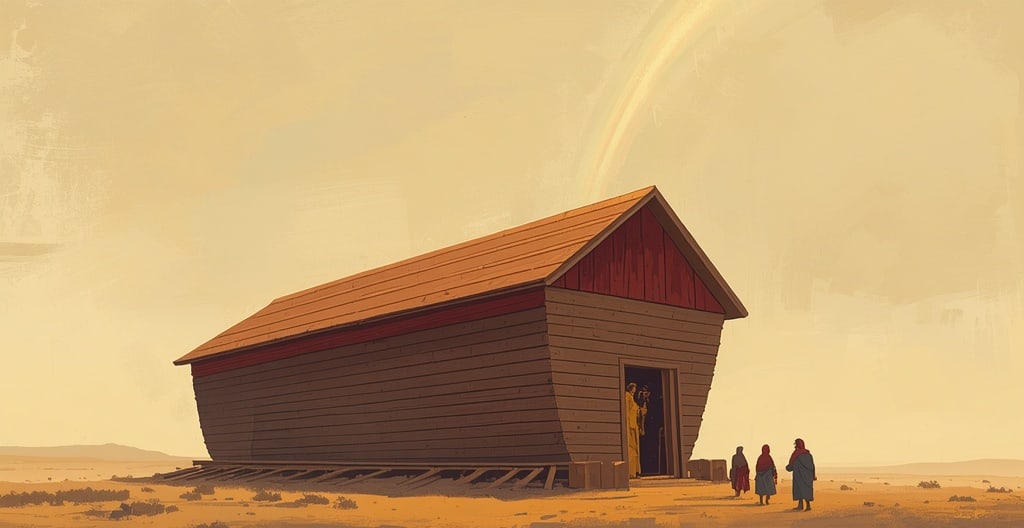
A world full of evil (6:5 to 22). Skip forward many generations. Sin has not shrunk. It has spread everywhere. Genesis 6:5 says God saw that the thoughts of the human heart were evil all the time, and he was grieved (verse 6). Not hot-tempered anger, but the sorrow of a father watching his children destroy themselves. God decides to judge the world with a flood. But among all the people on earth there is one man, Noah, who walks with God. God tells him the whole plan in advance and commands him to build a huge boat.
Notice that God gives the dimensions, the materials, everything. Noah does not invent his own way to survive. He simply believes and obeys, before a single drop of rain has fallen (Hebrews 11:7 speaks about this faith).
The flood and the single ark (7:17 to 23). The flood really comes. Every living thing on the land dies, except the people and animals inside the ark. I want you to notice that there was one ark, with one door (6:16). There was no other way to be saved. No one survived by being a strong swimmer, or by being a better person than the neighbors. Everyone who was saved was saved by being inside the boat God designed. And Genesis 7:16 says that God himself shut the door.
The sacrifice and the rainbow (8:20 to 22 and 9:8 to 17). When the water goes down, the first thing Noah does on dry ground is build an altar and offer animals. Once again a life dies before God. God accepts it, and makes a covenant with Noah and with every living creature on earth that he will never again destroy the world with a flood. He sets the rainbow in the sky as a sign. Notice that the rainbow is not there to remind us. God says that when he sees it, he will remember his own covenant (9:15 to 16). God binds himself with a promise.
How this points to Jesus
- Two kinds of blood. Abel's blood cries out from the ground for justice, and rightly so. But the book of Hebrews says the blood of Jesus speaks something better (Hebrews 12:24). It does not cry out for the guilty to be punished, but for the guilty to be forgiven. Abel was an innocent man killed by his brother. Jesus was the innocent one killed by the very people he came to save, and he died for them.
- One way out, provided by God. One ark, one door, designed by God, shut by God. Jesus speaks about himself in exactly this way. He says he is the way, and that no one comes to the Father except through him (John 14:6). Elsewhere he says he is the door (John 10:9). That sounds narrow, but think about the flood. One open door is not narrow-mindedness. It is mercy, because it is open to everyone willing to come in.
- The flood and baptism. Peter, one of Jesus' disciples, writes that the flood is a picture of baptism (1 Peter 3:20–21). The same water that judged the world also lifted the ark and kept it afloat. Those who are in Jesus pass safely through judgment, not because they outran the water, but because they are in the boat.
- A God who judges and rescues at the same time. In this story God does not overlook evil, and he does not abandon people either. Those two things meet at the cross, where sin is truly dealt with and sinners are truly rescued in a single event.
Words to know
The words sacrifice (เครื่องบูชา) and altar (แท่นบูชา) appear often from here on. In the Bible a sacrifice is not trading an object for merit or keeping God happy. It is a picture God gave in advance, to teach that sin costs a life, and that one day he would pay that price himself. If you are used to bringing offerings to a temple, notice that in this story God is not interested in the gift at all, but in the heart of the person offering it.
The word covenant (พันธสัญญา) means, simply, a binding agreement. But God's covenants differ from agreements between people: God is the one who starts them, and he binds himself first. The rainbow is the first example. The two parts of the Bible, the Old Testament and the New Testament, take their names from this word.
When you see the word พระองค์ in your Thai Bible it almost always means God. It is the same kind of pronoun as "he" or "him," but raised to the highest honor. Try reading it as "God" every time you meet it, and the sentences get easier.
Reflect
- God warned Cain before he did wrong (4:6 to 7). Have you ever felt something warning you before a bad decision? Where do you think that voice comes from?
- Noah built the ark for years without seeing rain. How is that kind of faith like, or unlike, the faith you are familiar with?
- Everyone in the ark was saved by the ark, not by themselves. Does that idea make you comfortable or uneasy? Why?
Pray
"God, I can see that sin spreads faster and further than I thought. Thank you that you do not overlook evil, and that you do not abandon people either. Help me understand what the ark you have prepared for me is. Amen."