Getting to know Jesus · Lesson 6
The Tabernacle and the Day of Atonement. Blood That Covers Sin, and the Curtain That Kept People Out
Listen to the lesson in Thai
Audio loads when you press play.
Read the passage first
Read Exodus 25:8–9, just two verses. Then read Leviticus 16:1–10 and 16:15–22. After that read a single verse, Leviticus 17:11.
A warning first: this is the hardest reading on our whole path. It is full of rituals, names of objects, and strange words. That is completely fine. You do not need to understand every step. Hold on to three main ideas: God wants to be close to his people, something stands in the way, and God himself sets up the way to deal with what stands in the way.
What happens in this passage
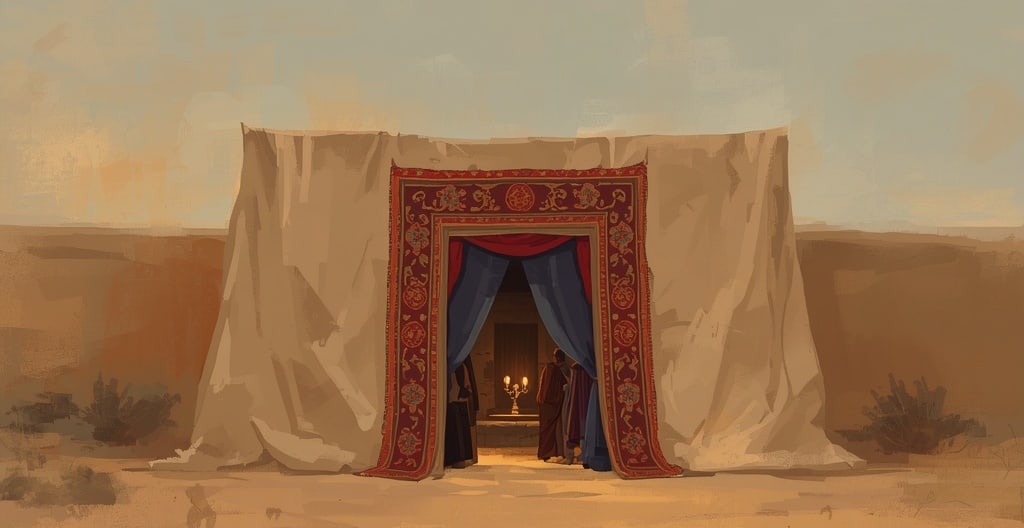
God wants to live among his people (Exodus 25:8 to 9). After leaving Egypt, the people of Israel travel through the wilderness, a dry desert. God tells Moses to build a large tent called the tabernacle, and gives the reason plainly: so that he can dwell among them. This is remarkable. Since Adam and Eve left the garden, no human being had been close to God like that. Now God is the one asking to come back and live near them. But notice that God designs everything himself, as with Noah's ark. People do not work out for themselves how to approach God.
The curtain that kept people out. The tabernacle was divided into sections. The innermost part was a small room your Bible may call the Most Holy Place (อภิสุทธิสถาน), which simply means "the holiest room." In that room stood a gold-covered wooden chest called the ark of the covenant, and God said he would be there. In front of this room hung a thick, heavy curtain. No one could walk through it. Picture it: God right there, very near, in the middle of the camp, and yet something still in the way. That curtain told two truths at once. God is with us, and our sin still keeps us from going straight in to him.
One day a year, one man in the whole nation (Leviticus 16:1 to 10 and 15 to 17). Only one person could go behind the curtain: the high priest, the head of those who served God in the tabernacle. And he could go only one day a year, called the Day of Atonement. Before going in he had to offer an animal for his own sin, because he was a sinner too. Then he killed a goat for the sin of the whole nation, carried its blood behind the curtain, and sprinkled it on the lid of the ark. That blood covered the sin of the whole nation before God for that year.
A second goat sent far away (16:20 to 22). Then came another part of the ritual that is a very clear picture. The high priest placed both hands on the head of a second goat, still alive, and confessed all the sins of the people over its head, as if moving all their sin onto the goat. Then someone led that goat out into the wilderness and released it, far away, never to come back. The sin of the whole nation was carried far off where no one would see it again. (Your Bible may have an unusual name for this goat, with an explanation in a footnote. Do not worry about the name. Look at the picture.)
The principle behind all of it (17:11). This verse explains why, from the clothes of skin in Eden, to Abraham's ram, to the Passover lamb, to this day, there always had to be blood. God says that the life of a creature is in its blood, and that he has given blood on the altar to make atonement for sin. Put simply: sin cuts life off, so the remedy has to cost a life. God is not saying animal blood has magic power. He has appointed it as a picture, to teach his people how serious sin is and how much forgiveness costs.
And all of this had to be repeated every year, year after year, because it never truly dealt with sin. It only covered it for a time, waiting for the day the real thing would come.
How this points to Jesus
The book of Hebrews in the New Testament explains this chapter almost picture by picture.
- High priest and sacrifice in one person. Hebrews 9:11–14 says Jesus is the high priest greater than any other. He went in to God on our behalf, but he did not carry the blood of goats or calves. He carried his own blood. He is both the one who offers and the offering.
- Once is enough. The high priest had to repeat the ritual every year, because animal blood never truly removed sin. But Hebrews 10:10–14 says Jesus offered himself once, and that once was enough for everyone, forever. Nothing has to be repeated. No ceremony has to be added each year, because the work is finished.
- The curtain torn. On the afternoon Jesus died, Matthew 27:51 records that the curtain in the temple (the permanent version of the tabernacle, built later in Jerusalem) was torn in two, from top to bottom, not from bottom to top. God tore it, not people. The curtain that had said "keep out" for thousands of years was open. So Hebrews 10:19–22 says we can now come to God with confidence, without waiting for a high priest, without waiting for one day a year.
- The goat that carried sin away. Jesus is also like the second goat. Our sin was placed on him, and he carried it far from us. Psalm 103:12 speaks of God removing our sin as far as the east is from the west. Jesus is how he did it.
Words to know
The word atonement (ลบมลทิน) is the Thai Standard Version's term. มลทิน means a stain or dirt, so ลบมลทิน means to wipe the stain away, to make clean. The English word carries the sense of being made "at one" again, reconciled. The two meanings go together: when sin is dealt with, the relationship is restored.
The words priest (ปุโรหิต) and high priest (มหาปุโรหิต) mean the person who stood between God and the people and offered sacrifices on their behalf. This is different from the monks we are familiar with, whose role is to teach and to practice the way as an example. A priest's main work was dealing with sin by blood before God.
The tabernacle (พลับพลา) was the tent God had them build. The temple (พระวิหาร) was the permanent building put up later in Jerusalem that served the same purpose. Both had a curtain closing off the inner room.
Reflect
- God wanted to live among his people, yet there had to be a curtain. What do those two facts together say about God?
- Have you ever felt that something stood between you and God? What was it?
- The curtain tore from top to bottom, not from bottom to top. Why do you think that detail matters?
Pray
"God, I see that you have wanted to be near people from the very beginning, even with sin in the way. Thank you that you did not wait for me to find a way in, but opened the way yourself. Help me understand that Jesus really has opened that curtain for me. Amen."