Walking with Jesus · Lesson 1
Lot's Wife. Out of the City, but Her Heart Stayed Behind
Listen to the lesson in Thai
Audio loads when you press play.
Read the passage first
Read Genesis 18:16–33, then Genesis 19:1–29. Finish with Jesus' words in Luke 17:26–33.
This is the first lesson of Walking with Jesus. These lessons follow the first path, for anyone who has said yes to Jesus, or is about to, and wants to know what following him looks like in real life. Parts of this story are hard to read. If something stops you, ask in the question box below.
What happens in this passage
Abraham pleads for the city (Genesis 18:16 to 33). Remember Abraham from lesson 4? God tells Abraham that the outcry against the wickedness of Sodom and Gomorrah has reached him. These two cities lie in the fertile plain of the Jordan River, and Abraham's nephew Lot has gone to live there. Abraham does not rejoice that wicked people will be punished. He pleads with God, asking whether God would still destroy the city if fifty righteous people were found there. Then he asks again and again for fewer: forty-five, forty, thirty, twenty, all the way down to ten. Each time God answers that he will not destroy it for their sake. Notice that God is never annoyed by Abraham's pleading. He does not want to destroy. But the city did not have even ten righteous people.
A city that forgot God (19:1 to 11). Two angels arrive in the city looking like ordinary men. Lot invites them to stay at his house. That night the men of the whole city, old and young, surround the house and demand that the guests be sent out so they can rape them. The whole city is ready to assault defenseless strangers. Other parts of the Bible describe this city's wickedness from several sides. The prophet Ezekiel says Sodom was proud, had more than enough to eat, lived at ease without a care, yet did not reach out to help the poor and needy, and did detestable things before God (Ezekiel 16:49–50). Jude adds that they gave themselves to serious sexual sin (Jude 7). It was not one sin, but a whole city that had stopped caring about God and stopped caring about other people.
Verse 8 is shocking to read. Lot offers his own daughters to the crowd instead. The Bible does not praise this. It shows how far the city had swallowed Lot himself. People who live in darkness long enough begin to lose sight of what is right and what is wrong.
Mercy that takes the hand (19:12 to 22). The angels tell Lot to take his family and leave, because God is about to destroy the city. Lot goes to the men engaged to his daughters, but they think he is joking. Toward dawn the angels urge him to hurry, but Lot still lingers. Verse 16 says something very important: the angels take Lot by the hand, take his wife and both his daughters by the hand, and bring them outside the city, because the LORD was merciful to him. They were not saved because they were brave or quick to obey. They were saved because God led them out by the hand. Then the angels command: flee for your lives, do not look back, and do not stop anywhere in the plain.
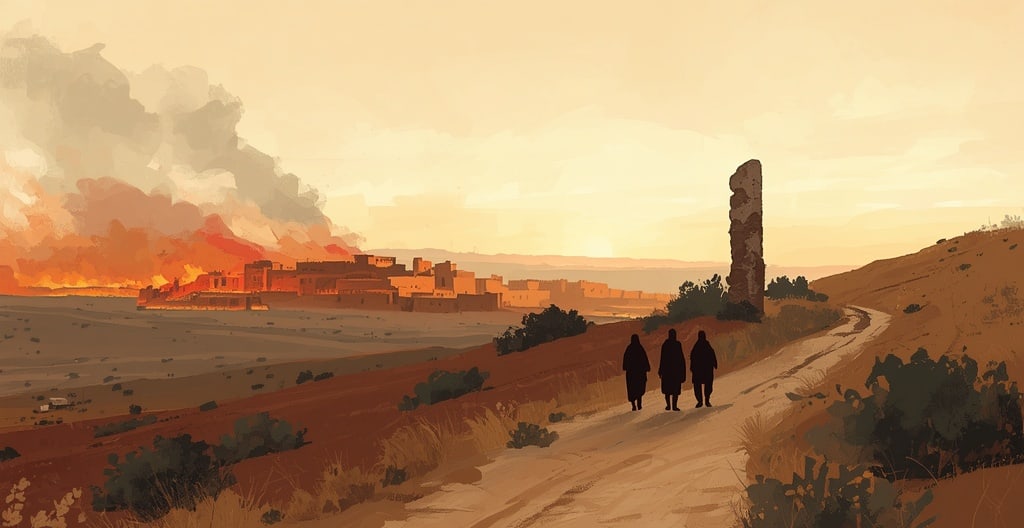
Do not look back (19:23 to 29). As the sun rises, God rains sulfur and fire on the two cities, and everything is destroyed. But verse 26 says, very briefly, that Lot's wife looked back, and became a pillar of salt.
She did not simply glance over her shoulder at a loud noise. The Hebrew word used here often means a deliberate, lingering look. Her body was moving forward toward safety, but her heart was still tied to that city: her home, her things, her comfort, the life she had known. She lost her life because she let a brief longing for a dying world weigh more than her trust in the living God who was leading her to safety.
Many have read the pillar of salt this way. In that world salt was used to keep food from spoiling, but land full of salt is land where nothing grows. So Lot's wife was preserved in the very state her heart chose when she turned back, a monument to the destruction she was running from.
How this points to Jesus
- Jesus himself tells us to remember her. In Luke 17 Jesus speaks about the day he will return, and says it will be like the days of Lot: people eating, drinking, buying, selling, planting, building, living as usual, and then the day arrives without warning. Then he says one of the shortest sentences in the Bible: remember Lot's wife (Luke 17:32). And he goes on to say that whoever tries to keep their life will lose it, but whoever loses it will keep it alive (verse 33). Time is not in our hands, as we talked about in lesson 14.
- Ten righteous people, and one Righteous One. Abraham asked that the city be spared for the sake of ten righteous people, but they could not be found. The Bible says no one is righteous, not even one (Romans 3:10). Then God did what Abraham never dared to ask. He sent one righteous person, Jesus, to die for the unrighteous, to bring us to God (1 Peter 3:18). And today Jesus still pleads for us (Hebrews 7:25), like Abraham, but far greater.
- God takes our hand first. Lot lingered, but the angels took him by the hand and led him out because of mercy. This is a picture of what Jesus does. He came to seek and to save the lost (Luke 19:10), and he rescues us from the power of darkness (Colossians 1:13). Salvation starts with his hand, not with our courage.
- A divided heart cannot keep walking. Jesus said that no one who puts a hand to the plow and looks back is fit for the kingdom of God (Luke 9:62). Paul says he forgets what lies behind and presses on toward what lies ahead (Philippians 3:13–14). Following Jesus is not walking forward with our feet while our heart stays in Sodom. It is turning our whole heart to look at him (Hebrews 12:2).
- Let go of what is dying, and take hold of God. You may know the idea of letting go (ปล่อยวาง). What the Bible asks is not to let go of everything until the heart is empty, but to let go of sin and the old life that is dying, and to take hold of the living God who is leading us to safety. And turning your back on the old life does not mean leaving your family or no longer loving the people at home. Lot himself tried to bring his family out with him. What we leave behind is sin, not people.
- If you notice your heart looking back, do not stand still. People who follow Jesus still have days when they miss the old life, and still face temptation. That does not mean you have already become a pillar of salt. It is a signal to turn back to him at once and tell him plainly. The Bible promises that if we confess our sins, he will forgive us and make us clean (1 John 1:9). Do not wait until a heart that looks back becomes a heart that stands still.
Words to know
The phrase pillar of salt (เสาเกลือ) in Genesis 19:26 means a mass of salt standing like a pillar. Around the Dead Sea, where Sodom is thought to have been, there are still many strangely shaped salt rocks today, and the land is so salty that almost nothing grows.
The word sulfur (กำมะถัน, called brimstone in some English Bibles) in verse 24 is a yellow mineral that catches fire easily and has a sharp smell. The Bible uses fire and sulfur as a picture of judgment.
The word judgment (การพิพากษา) means God judging evil justly. Unlike karma, which works on its own like a law of nature, judgment in the Bible comes from God as a person, who is just and merciful at the same time, and who always opens a way of escape first. In this story the way out was the angels' hands. Today the way out is Jesus.
The word righteous (คนชอบธรรม), which 2 Peter 2:7 uses of Lot, does not mean Lot was a flawless man. We have seen how badly he failed. It means someone God counts as right before him because of faith, not because of their record. And verse 9 says the Lord knows how to rescue his people from trials.
Reflect
- Lot's wife had left the city with her body, but her heart was still behind. Is there something from your old life that your heart keeps turning back to?
- The angels took Lot by the hand and led him out while he was still lingering. How does it feel that God does not wait for us to be brave before he helps us?
- Jesus says, remember Lot's wife. This week, what would looking ahead to Jesus, instead of looking back, look like in your real life?
Pray
"God, thank you that you did not wait for me to be brave first, but took my hand and led me out in mercy. My heart still likes to look back at the things you have rescued me from. Help me let go of them and hold on to you. Let my eyes and my heart look ahead to Jesus, every day. Amen."