Getting to know Jesus · Lesson 13
The Resurrection. Death Defeated, and the People Who Saw It With Their Own Eyes
Listen to the lesson in Thai
Audio loads when you press play.
Read the passage first
Read Luke 24:1–12 and 24:36–49, then John 20:1–29. Finish with 1 Corinthians 15:1–8 and 15:17–22.
The last lesson ended in darkness. This one begins at dawn. As you read, notice how the people in the story respond. You will see that none of them believed easily.
What happens in this passage
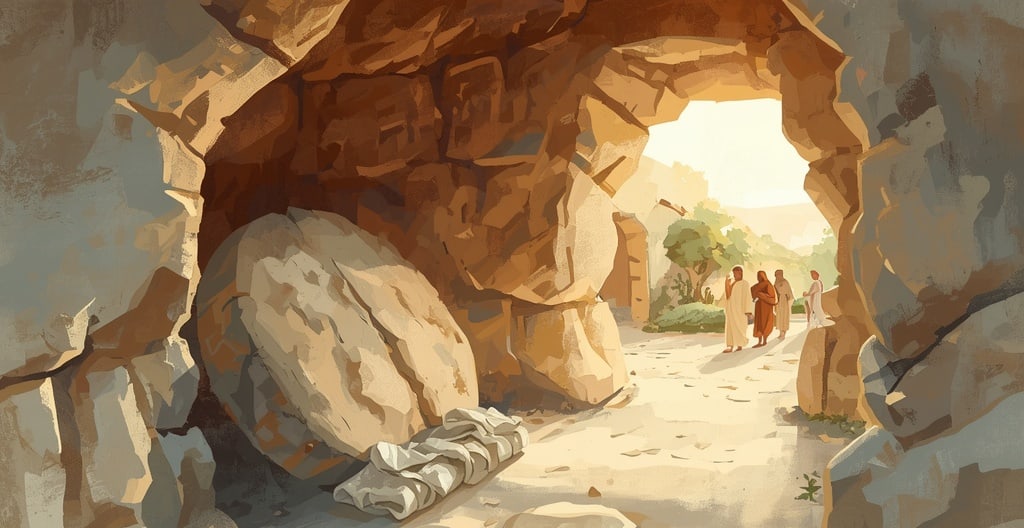
The empty tomb (Luke 24:1 to 12). After Jesus died, his friends laid his body in a tomb cut into rock, sealed it with a large stone, and the authorities posted guards. That was Friday. Early on Sunday morning a group of women who had followed Jesus go to the tomb to anoint the body with spices, as custom required. They go to care for a dead man, not to look for a living one. But the stone has been rolled away, the tomb is empty, and an angel asks them why they are looking for the living among the dead. He has risen, just as he said he would.
The women run to tell the disciples, and the disciples do not believe them (verse 11). They think it is nonsense. Peter runs to see for himself, finds the tomb empty and the burial cloths lying there, and is still bewildered. Notice that the Bible does not paint the disciples as people ready to believe anything. They were ordinary people who knew that the dead do not come back.
Notice too that the first witnesses are women. In those days a woman's testimony carried little weight in court. Anyone inventing a story for people to believe would not have started it this way. The Bible tells it this way because this is how it happened.
Not a ghost (Luke 24:36 to 49). That evening Jesus appears before the disciples, who are hiding in a room. They are terrified and think they are seeing a ghost. Jesus tells them to look at his hands and feet, to touch him: a ghost does not have flesh and bones. Then he asks for food and eats fish in front of them. This is a crucial point. The Jesus who came back is not a spirit, not a memory lingering in his friends' hearts, not a vision, but a real body that can eat, can be touched, and bears the same wounds.
Thomas (John 20:19 to 29). One disciple, Thomas, was not in the room that night. When his friends tell him, he says plainly that unless he sees the nail marks in the hands and puts his own finger into the wound in the side, he will not believe. A week later Jesus comes again and turns directly to Thomas, telling him to go ahead and touch. Thomas no longer needs to. He says that Jesus is his Lord and his God (verse 28). This is the first time anyone calls Jesus God directly to his face, and Jesus does not stop him. He accepts it. Then Jesus speaks of those who have not seen and yet believe, and calls them blessed. That includes you.
The evidence Paul gathered (1 Corinthians 15:1 to 8). Paul writes this letter about twenty-some years after the events. He passes on what he himself received: that Christ died for our sins, was buried, and rose on the third day, as the Scriptures had said in advance. Then he lists the people who saw Jesus afterward: Peter, the whole group of disciples, more than five hundred people at once, James the brother of Jesus who had once not believed, and Paul himself, who had once hunted Christians. And he adds that many of these people are still alive; go and ask them. These are the words of someone confident that the story can be checked.
If Jesus was not raised (15:17 to 22). Paul speaks very bluntly. If Christ has not been raised from the dead, the Christian faith is worthless, sin remains, and those who have died are lost. He does not say "believe it anyway, for comfort." He says everything depends on whether it really happened. Then he says it did, and that Jesus is the firstfruits, like the first fruit of the season that tells you the rest is coming. Death came through Adam; life comes back through Christ.
How this points to Jesus
- The serpent's head crushed. In Genesis 3:15 God promised that the woman's offspring would be struck on the heel but would crush the serpent's head. The cross is the strike. Sunday morning is the crushing. The death that entered the world in Genesis 3 has lost. Satan still exists, but his final weapon has lost its power (Hebrews 2:14–15).
- "It is finished," confirmed. If Jesus had died and not come back, "it is finished" would just be the words of a dying man. But the resurrection is God saying he has accepted that sacrifice. The debt really is paid, like a receipt stamped (Romans 4:25).
- Not rebirth, but the same person raised. This is the place to stop and think. In the idea of the cycle of rebirth, someone who dies is born as a new person, in a new body, remembering nothing, and still in the cycle where they must die again. But Jesus was not reborn as anyone. He came back as the same Jesus: he recognized his disciples, bore the same wounds, ate with them as before. Yet his body was made new: no sickness, no aging, no dying again. And the Bible says this is what awaits those who believe in him too. Not release from having a self, but becoming fully yourself, with God forever.
- A story people saw with their own eyes. Christians do not believe this because it is a beautiful teaching, but because people saw him, touched him, and ate with him, and many of them later died rather than deny that what they saw was real. People do not die for a story they know they made up.
Words to know
The phrase rose from the dead (เป็นขึ้นจากตาย, or ทรงเป็นขึ้นมา in your Bible) means that someone who had truly died came back to life in a new body that will not die again. Not waking from a faint, not a ghost, and not being born again in another body. Thai had no word for this before, because nothing like it had ever happened before.
The title Lord (องค์พระผู้เป็นเจ้า), which Thomas uses for Jesus, is the word the Old Testament uses for God. When Thomas uses it for Jesus, he is saying that Jesus is God.
The word firstfruits (ผลแรก) means the first fruit to ripen in the season. When a farmer sees it he knows the whole orchard is about to follow. Paul uses this picture to say that Jesus' resurrection is not a one-off event but the first of what will happen to everyone who belongs to him.
Reflect
- The disciples themselves did not believe at first, and Thomas asked for evidence. How do you think Jesus feels about people who doubt? Is there a question you would like to ask, the way Thomas did?
- Paul says that if Jesus was not raised, everything is worthless. Why do you think he dared to say that?
- Resurrection differs from rebirth in that Jesus remained the same person. How does the idea that you would still be you, but made whole and with God forever, make you feel?
Pray
"Jesus, if you really rose from the dead, then everything changes. I am like Thomas: I want to see before I believe. But you said that those who do not see and yet believe are blessed. Please help me believe, and let me know that death is not the end. Amen."