Getting to know Jesus · Lesson 8
David. The King God Promised, and the Song That Told of the Cross in Advance
Listen to the lesson in Thai
Audio loads when you press play.
Read the passage first
Read 2 Samuel 7:8–16, then read Psalm 22:1–18 slowly, and finish with Psalm 23, one of the most loved chapters in the world.
We have jumped about four hundred years from the last lesson. Israel is now living in the land God promised, and has a king. David is the second king. He began as a shepherd boy, the youngest son whom no one counted, but God chose him.
What happens in this passage
The promise to David (2 Samuel 7:8 to 16). David is Israel's greatest king. Once he is settled, he wants to build a house for God, a temple. But God sends a prophet named Nathan to tell him the opposite: God is the one who will build a house for David. In God's sense, though, "house" does not mean a building but a dynasty, a line of descendants who will reign after him.
God promises that one of David's descendants will have God as his father, and that his throne will be secure forever (verses 12 to 16). Think about that. Every human king dies. Every dynasty eventually falls. But God says forever. That word is impossible for an ordinary king, unless there is a king who does not die. From that day Israel began waiting for this king, and called him "the anointed one": Messiah in Hebrew, Christ in Greek.
Notice too that this promise does not depend on David's goodness. David later does something gravely wrong (the story is in 2 Samuel 11), but God does not cancel the promise, because it rests on God's faithfulness, not a man's. Like Noah's rainbow, and like Abraham's stars.
A song that told of the cross in advance (Psalm 22:1 to 18). David wrote many songs, collected in the book of Psalms. Psalm 22 is a strange and painful one. It opens with a man crying out to God, asking why God has abandoned him. Then it goes on: the people around him mock him and shake their heads, saying that if God really loves him, let God rescue him. He is so thirsty his tongue sticks to the roof of his mouth. His hands and feet are wounded. His bones are pulled out of joint. The people there stare at him, and they cast lots to divide his clothes among themselves.
David wrote this about a thousand years before Jesus was born, and here is the thing: nothing in David's own life matches this psalm as a whole. He was not crucified. No one cast lots for his clothes. Crucifixion did not even exist yet. It is as if David were seeing something far beyond his own life.
And I want you to notice that the psalm does not end in darkness. If you read on to the end (verses 22 to 31) it turns into praise, and says that every nation on earth will turn to God because of what he has done.
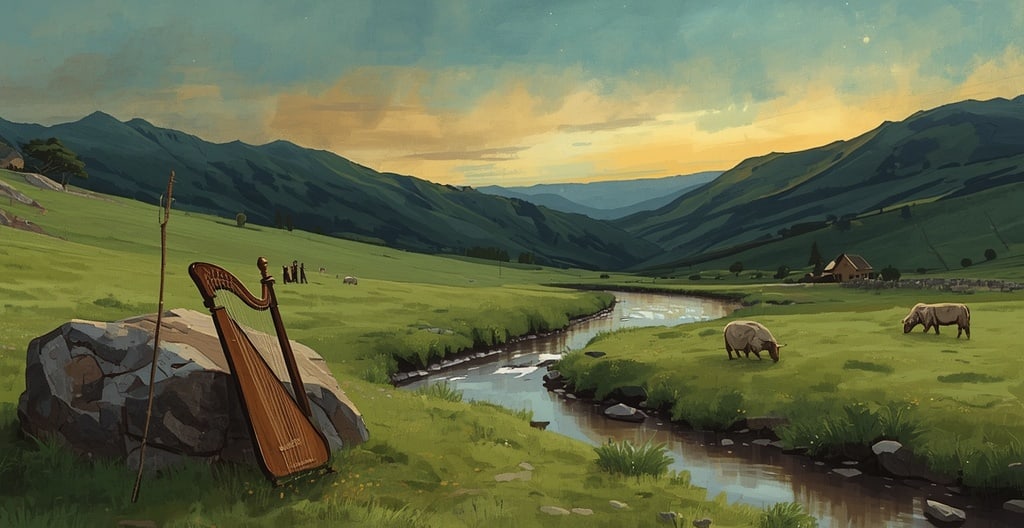
The shepherd (Psalm 23). From the darkness of Psalm 22, the next psalm is the warmest picture in the Bible. David, who had once been a shepherd boy, writes that God is his shepherd and he is the sheep. A good shepherd makes sure the sheep lack nothing, leads them to water, leads them to safe places, walks with them even through the darkest and most frightening valley, follows the sheep with goodness and love that never gives up, and in the end the sheep lives in the shepherd's house forever.
Notice that the sheep in this psalm does nothing at all. It does not find its own grass. It does not defend itself. It does not find its own way home. Everything is the shepherd's work.
How this points to Jesus
- A king who reigns forever. About a thousand years after the promise to David, an angel came to a young woman named Mary and told her she would have a son, to whom God would give the throne of his ancestor David, and he would reign forever, without end (Luke 1:32–33), using the very words of 2 Samuel 7. Jesus was born in David's line, in Bethlehem, David's town. And after he rose from the dead he never died again. A king who reigns forever is possible in him alone.
- The cry from the cross. On the afternoon Jesus hung on the cross, he cried out the first words of Psalm 22, asking God why he had forsaken him (Matthew 27:46). Not because he had lost hope, but because he was telling everyone standing there that this song was coming true in front of them. And Psalm 22 ends in praise. Jesus knew the ending.
- Details that match. The people standing there mocking and shaking their heads (Matthew 27:39), the hands and feet pierced with nails, the thirst (John 19:28), and the soldiers casting lots for his clothes (John 19:23–24, where John adds that this happened to fulfill the Scripture). All of it was in Psalm 22 a thousand years earlier.
- The good shepherd. Jesus said that he is the good shepherd, and that the good shepherd lays down his life for the sheep (John 10:11). Set Psalms 22 and 23 side by side. The shepherd of Psalm 23, who leads the sheep through the dark valley, is the same one who walked into the darkness of Psalm 22 himself, so that the sheep would not have to.
Words to know
The word Psalms (สดุดี) is the name of the book that collects songs and poems sung to God. There are a hundred and fifty of them, many written by David. In the Psalms there is praise, weeping, complaint, confession, and blunt questions put to God. God does not forbid his people to ask hard questions.
The word Christ (พระคริสต์), which you will see after Jesus' name, is not a surname but a title. It means "the anointed one," that is, the very king God promised David. In Hebrew the word is Messiah. Every time you see "Christ," think of 2 Samuel 7.
The word shepherd (ผู้เลี้ยง or ผู้เลี้ยงแกะ) was, in those days, a lowly, dirty, and dangerous job, not a position of honor. Yet God chose this picture for himself, and Jesus used it for himself too. That tells us God does not consider it beneath him to come down and care for us closely.
Reflect
- The promise to David did not depend on David's goodness but on God's faithfulness. How do you feel about a God who keeps his promise even when a person fails?
- David asked God directly why he had abandoned him. Do you think we can speak to God like that? Is there something you would like to say to God that you never have?
- In Psalm 23 the sheep does nothing; everything is the shepherd's work. If you were the sheep in this psalm, which part of it would you most want right now?
Pray
"God, you promise and you always keep your promise, even when it takes a thousand years. Thank you that Jesus walked into the darkest valley in my place. Please be my shepherd too. Amen."