Walking with Jesus · Lesson 3
He Knows You by Name. Three Who Heard "I Do Not Know You"
Listen to the lesson in Thai
Audio loads when you press play.
Read the passage first
Read Matthew 7:15–27, then Mark 10:17–27 and Matthew 25:1–13. Finish with John 10:1–15 and John 10:27–30.
In the last lesson we saw Peter and Judas, two men who failed Jesus, and the difference was where each one turned. In this one Jesus tells us about three kinds of people who seemed close to the kingdom of God and were still left outside. These are some of the most serious words Jesus ever spoke. Read them slowly, and read them about yourself, not about other people.
What happens in this passage
The ones who did great things in his name (Matthew 7:15 to 27). Jesus says a tree is known by its fruit. A healthy tree bears good fruit, and a diseased tree bears bad fruit (verses 16 to 20). Then he says: "Not everyone who says to me, 'Lord, Lord,' will enter the kingdom of heaven, but the one who does the will of my Father who is in heaven" (Matthew 7:21, ESV). On that day many will come to him and list what they did in his name: they prophesied, they drove out demons, they did many mighty works. And Jesus will answer them: "I never knew you; depart from me, you workers of lawlessness" (Matthew 7:23, ESV).
Notice what Jesus does not say. He does not say, "You did not do enough." These people did a great deal. Notice also what they point to on that day. They don't point to Jesus and what he did for them; they point to themselves and what they did for him. Their confidence was in their record. And their lives told the truth about their hearts. Jesus calls them workers of lawlessness: they were busy with religion, but they did not obey him, and they did not know him.
What, then, is the will of the Father? Jesus answers in John 6: the work God asks for is to believe in the one he has sent (John 6:29). The Father's will is that everyone who looks to the Son and believes in him should have eternal life (John 6:40). Faith in Jesus comes first, and real faith does not stay empty; it bears fruit. That is why Jesus ends with two builders (Matthew 7:24 to 27). Both heard his words. One did what he said and built his house on rock. The other did not, and built on sand. When the storm came, the house on the sand fell, and great was its fall.
The man who asked what he must do (Mark 10:17 to 27). A man runs up to Jesus, kneels before him, and asks, "Good Teacher, what must I do to inherit eternal life?" (Mark 10:17, ESV). Jesus first asks why he calls him good, since no one is good except God alone (verse 18). Then Jesus names commandments about how we treat others: do not murder, do not commit adultery, do not steal, do not bear false witness, do not defraud, honor your father and mother. The man answers that he has kept all of these since he was young.
Then comes verse 21: Jesus looked at him and loved him. Because he loved him, he told him the truth. The man lacked one thing: go, sell everything you have and give to the poor, and you will have treasure in heaven; then come, follow me. At these words the man's face fell, and he went away sad, because he had great possessions (verse 22).
Jesus put his finger on the one thing this man loved more than God. Elsewhere Jesus says plainly that no one can serve both God and money (Matthew 6:24). The man was willing to keep rules, but he was not willing to give Jesus his heart. Notice also that Jesus did not run after him and lower the price. He let him go.
Jesus did not command every follower to sell all their possessions. This command was for this man and the thing that ruled his heart. But the principle is for everyone: Jesus said that anyone who does not give up everything they have cannot be his disciple (Luke 14:33). Whatever you love more than Jesus, he asks you to lay down.
Then Jesus told his disciples that it is easier for a camel to go through the eye of a needle than for a rich person to enter the kingdom of God (verse 25). Astonished, they asked who then can be saved. Jesus looked at them and said: "With man it is impossible, but not with God. For all things are possible with God" (Mark 10:27, ESV). This is the heart of it. No one can do enough to inherit eternal life. What we cannot do, God does.
The ones whose lamps went out (Matthew 25:1 to 13). Jesus tells a story about a wedding. Ten young women take their lamps and go out to meet the bridegroom. Five are wise and take extra oil with their lamps. Five are foolish and take none. The bridegroom is delayed, and they all fall asleep. At midnight comes the cry: the bridegroom is here, come out to meet him! The foolish ones find their lamps going out and ask the wise for some of their oil. The wise answer that there will not be enough for both, so they must go and buy their own. While they are gone, the bridegroom arrives. Those who were ready go in with him to the wedding feast, and the door is shut (verse 10).
Later the others come and call out, "Lord, lord, open to us." He answers, "Truly, I say to you, I do not know you" (Matthew 25:11–12, ESV). Then Jesus gives the point of the story himself: "Watch therefore, for you know neither the day nor the hour" (Matthew 25:13, ESV).
All ten looked the same at the start. They had lamps, they were dressed for the wedding, and they were in the right place. The difference only showed when the bridegroom came. Many teachers see the oil as a picture of the real inner life that God's Spirit gives, though Jesus does not explain it. What Jesus does make clear is this: readiness cannot be borrowed from someone else, and once the door is shut, it is shut. Remember Noah in lesson 3? The LORD himself shut the door of the ark (Genesis 7:16), and no one outside could open it.
How this points to Jesus
- The same cry, the same answer. In Matthew 7 and Matthew 25, people cry out "Lord, Lord," and both times Jesus answers that he does not know them. Calling Jesus "Lord" with our mouths is not the same as belonging to him. Being religious is not the same as being known by him.
- What it means to be known by God. God knows everything about everyone. But when the Bible speaks of God knowing a person in this way, it means belonging to him. Paul writes to believers that they have come to know God, or rather to be known by God (Galatians 4:9). And Jesus says what eternal life is: "And this is eternal life, that they know you, the only true God, and Jesus Christ whom you have sent" (John 17:3, ESV). The rich man asked how to inherit eternal life. Jesus' answer is himself.
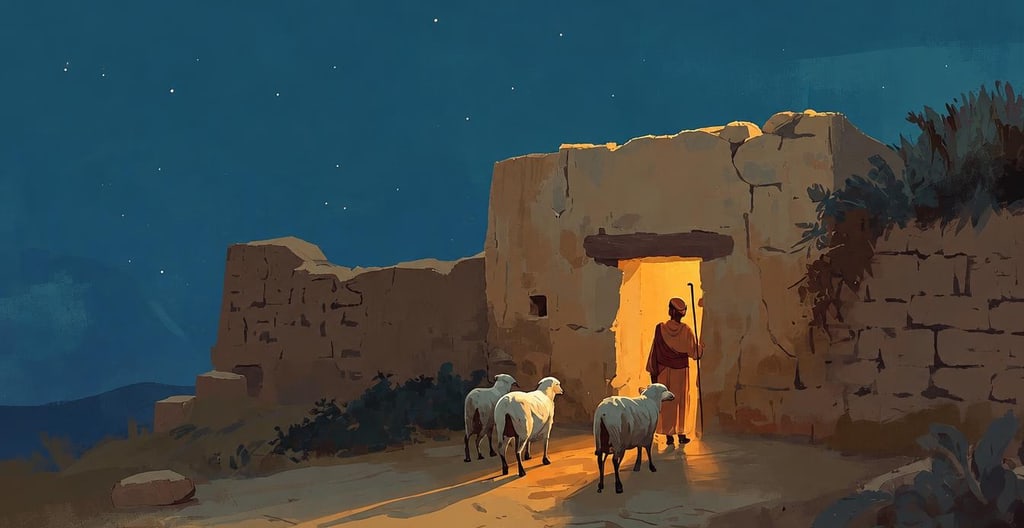
- The Shepherd who knows his sheep by name. In John 10 Jesus says the good shepherd calls his own sheep by name and leads them out (verse 3). He says, "I know my own and my own know me" (John 10:14, ESV), and that he lays down his life for the sheep (verse 11). Long before, God told his people: "Fear not, for I have redeemed you; I have called you by name, you are mine" (Isaiah 43:1, ESV). The same Jesus who will say "I never knew you" to the performers knows his own sheep by name.
- Not by works, but never without fruit. "For by grace you have been saved through faith. And this is not your own doing; it is the gift of God, not a result of works, so that no one may boast" (Ephesians 2:8–9, ESV), as we saw in lesson 14. God saved us because of his mercy, not because of anything good we had done (Titus 3:5). But Jesus also said, "If you love me, you will keep my commandments" (John 14:15, ESV). John writes: "And by this we know that we have come to know him, if we keep his commandments. Whoever says 'I know him' but does not keep his commandments is a liar, and the truth is not in him" (1 John 2:3–4, ESV). Faith without works is dead (James 2:17). Works do not save us. They show whether our faith is real, the way fruit shows what kind of tree it is.
- Merit, ritual and religion cannot make us known. If you grew up making merit, keeping precepts and taking part in ceremonies, you know how natural it is to measure yourself by what you have done. This lesson is a warning for everyone, including people who go to church. Offerings, ceremonies, temple visits, church attendance, prayers and Bible reading can all be done without knowing God. None of them can make us known by him. Jesus said that no one comes to the Father except through him (John 14:6). We become his only by turning to Jesus and trusting him.
- His sheep are safe in his hand. Here is the good news to hold on to. Jesus says: "My sheep hear my voice, and I know them, and they follow me. I give them eternal life, and they will never perish, and no one will snatch them out of my hand" (John 10:27–28, ESV). And no one can snatch them out of the Father's hand either (verse 29). John wrote to those who believe in the name of the Son of God so that they may know they have eternal life (1 John 5:13). You do not have to wonder whether you have done enough. You can know whether you belong to him. God's firm foundation stands with two seals on it: the Lord knows those who are his, and everyone who confesses the name of the Lord must turn away from wickedness (2 Timothy 2:19). Both are true at the same time.
Words to know
The word know (รู้จัก) is used in the Bible for more than knowing facts about someone. When God knows a person in this way, it means that person belongs to him, the way a shepherd knows his own sheep and a father knows his own child.
The word lawlessness, which Jesus uses in Matthew 7:23, means living as if God's commands do not apply to you, even while doing religious things.
The phrase eternal life (ชีวิตนิรันดร์) means more than life that goes on forever. It is life with God that begins now, by knowing him through Jesus (John 17:3), and it never ends. It is not a cycle of being born again and again, but one life, with God forever.
The word bridegroom (เจ้าบ่าว) is a name Jesus used for himself (Mark 2:19–20). The Bible pictures the end of history as a wedding feast between Christ and his people (Revelation 19:7–9). Being ready for the bridegroom means being ready to meet Jesus.
Reflect
- If Jesus asked you today what you are trusting in, would your answer point to what you have done, or to what he has done?
- The rich man walked away because he loved one thing more than Jesus. What would be hardest for you to lay down if Jesus asked?
- The wise could not give their oil to the others. Is your faith your own, or are you leaning on someone else's?
Pray
"Lord Jesus, I do not want to be someone who only calls you Lord. Search my heart. Show me anything I love more than you, and give me the strength to lay it down. I am not trusting in what I have done, but in what you have done for me on the cross. Thank you that you know your sheep by name, and that no one can snatch them out of your hand. Let me hear your voice and follow you, and be ready on the day you come. Amen."