People God Chose · Lesson 1
Abraham. Father of Many Nations by God's Promise

Listen to the lesson in Thai
Audio loads when you press play.
Read the passage first
This lesson covers several passages, so take your time. Read Genesis 12:10–20, then Genesis 15:7–21, then Genesis 16, then Genesis 20, and then Genesis 21:1–21. Finish with Romans 4:18–25.
This is the first lesson of People God Chose. In this series we meet the people God chose to carry out his plan on earth: Abraham, Isaac, Jacob, Joseph, Moses and others. The book of Hebrews lists many of them as people of faith (Hebrews 11). The Bible is honest that none of them was perfect. They were afraid, they made mistakes, and some fell into serious sin. We do not look at their mistakes to judge them. They were flawed, and so are we. We look because their stories show that God can use anyone, even sinners, to do his work. Every one of them loved God, God had a plan for each one, and he can work in your life too. And every story points ahead to Jesus.
You already met Abraham in lesson 4: his call, the night he trusted God under the stars, and the ram on the mountain. This lesson looks at the rest of his life, the hard parts that are easy to skip, because that is where we see how patient God was with him.
What happens in this passage
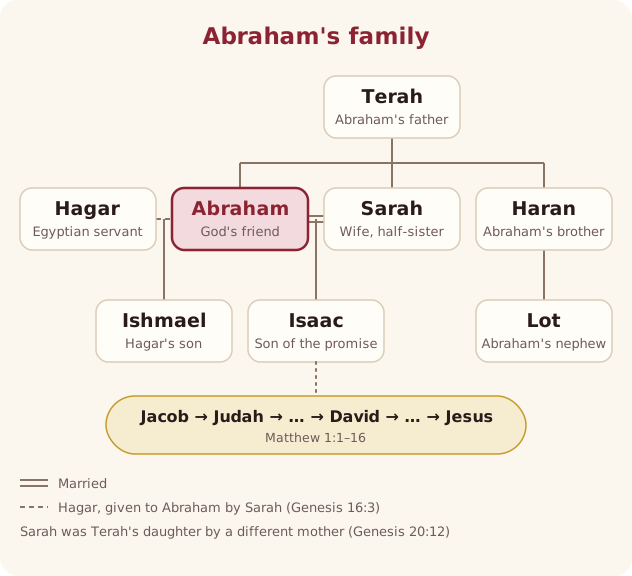
Famine, fear, and a half-truth (Genesis 12:10 to 20). Not long after God promises to make Abraham a great nation and bless every family on earth through him, a famine hits the land. Abraham is a real person under real pressure, with a family and herds to feed. Abraham goes down to Egypt. Notice what is missing. In the land he built altars and called on the name of the LORD (12:7–8), but nothing says he asked God before he left, and there is no altar in Egypt. On the way he becomes afraid. His wife Sarah is beautiful, and he thinks the Egyptians will kill him to take her. So he asks her to say she is his sister. It was a half-truth: she was his half-sister, the daughter of his father but not of his mother (20:12). But a half-truth told to deceive is still a lie. Most of us know that feeling: when we are afraid, we protect ourselves first.
The plan works the way he feared. Pharaoh takes Sarah into his palace, and Abraham is given sheep, cattle, donkeys, camels and servants because of her. The man through whom every nation was meant to be blessed brings plagues on Pharaoh's house instead. Then comes an embarrassing scene. A pagan king rebukes the man of God, asking why Abraham did this to him and why he did not tell the truth. Abraham has no answer. He leaves Egypt richer, but silent. And notice who rescued Sarah. Not Abraham. God stepped in, not because Abraham deserved it, but because God was protecting his promise. Sarah was the woman through whom the promised son would come.
When Abraham comes home, the Bible says he goes back to the place where he first built an altar, and calls on the name of the LORD again (13:3–4). That is what turning back looks like.
God makes a promise alone (15:7 to 21). Before we read Abraham's next mistake, we need a scene that explains the rest of his story. Abraham asks God how he can know the promise will come true. God tells him to bring some animals, cut them in half, and lay the halves in two rows. In that world this is how a serious agreement was made. The two parties walked together between the pieces, as if to say: may I become like these animals if I break my word. The prophet Jeremiah describes the same custom (Jeremiah 34:18–20).
But here something strange happens. Abraham falls into a deep sleep. In the dark, a smoking fire pot and a flaming torch, signs of God's presence, pass between the pieces alone. Abraham never walks through. God takes the whole oath on himself. It is as if God said: if this promise is broken, even if it is broken from your side, I will bear the cost. Keep this picture in mind. It explains why Abraham's failures never cancel the promise.
Helping God out (chapter 16). Ten years pass in the land, and there is still no child. Sarah has an idea that was common at the time: Abraham should have a child with her Egyptian servant, Hagar, and the child would count as Sarah's. Many think Hagar came into the household from that same trip to Egypt (12:16). The Bible says Abraham listened to the voice of Sarah. That is the same phrase God used to Adam in Genesis 3:17, when Adam listened to his wife and ate the fruit. And just as Eve took and gave the fruit, Sarah took Hagar and gave her to Abraham (16:3). The writer wants us to notice. This is another fall, a small one inside one family. They were not trusting God to keep his word in his way and his time. They were trying to make the promise happen with their own plan.
The result is pain all around. Hagar becomes pregnant and looks down on Sarah. Sarah blames Abraham. Abraham avoids responsibility and tells Sarah to do with Hagar whatever she likes. Sarah treats her so harshly that Hagar runs away into the desert, pregnant and alone.
Then comes one of the most tender moments in the Old Testament. This is the first time the Bible mentions the angel of the LORD, and he appears not to Abraham, but to a runaway foreign slave woman sitting by a spring in the wilderness. He calls her by name. He promises that her son, whom she is to name Ishmael (meaning God hears), will become a great people. And Hagar does something remarkable. She gives God a name: El Roi, the God who sees me (16:13). Abraham and Sarah did not treat her well, but God saw her.
Old fears come back (chapter 20). About twenty-four years have passed since Egypt. You might expect that fear to be gone. By now God has changed his name, promised that Isaac will be born within a year (18:10), and Abraham has pleaded with God for Sodom. Then, in the land of Gerar, the old fear comes back, and he does the same thing again. He says Sarah is his sister, and King Abimelech takes her. This happens just before Isaac is conceived (21:1–2). Once again, Abraham's fear puts the promise itself in danger.
Once again, God steps in. He warns Abimelech in a dream. When the king confronts him, Abraham's excuse is that he thought there was no fear of God in that place (20:11). The irony is painful. At that moment the pagan king feared God more than Abraham did. Yet look at what God says about Abraham to Abimelech: he is a prophet, and he will pray for you (20:7). And Abraham does pray, and God heals Abimelech's household (20:17). God still uses Abraham while he is standing there ashamed. Old fears can come back even after many years of walking with God. That does not mean God has given up on us.
God did what he had said (21:1 to 21). Chapter 21 begins with words that put the weight in the right place: the LORD visited Sarah as he had said, and did for her as he had promised. The emphasis is not on Abraham's faithfulness, but on God's. Abraham is a hundred years old. The boy is named Isaac, which means he laughs. Both Abraham and Sarah had once laughed in disbelief at the promise (17:17; 18:12). Now Sarah says God has given her laughter, the laughter of joy (21:6).
But the pain of chapter 16 does not disappear. Some years later Sarah demands that Hagar and Ishmael be sent away. Abraham is deeply distressed, because Ishmael is his son (21:11). God tells him to let them go, and promises to look after the boy. In the desert, when the water runs out and Hagar cannot bear to watch her son die, God hears the boy's voice, opens her eyes to see a well, and stays with Ishmael as he grows up. The Bible is honest. God forgives, but some choices still leave scars. And God cares for the people who got hurt along the way.
Still called God's friend. After all this, the Bible still calls Abraham by a remarkable title: friend of God (2 Chronicles 20:7; Isaiah 41:8; James 2:23). And Paul writes in Romans 4 that Abraham did not waver in unbelief, but grew strong in faith, fully convinced that God was able to do what he had promised (Romans 4:20–21). How can Paul say that about a man who stumbled the way Abraham did? Because the direction of Abraham's life, from the day he left home to the mountain in chapter 22, was trusting God, even with all his stumbles. And because God's verdict on Abraham was already given in Genesis 15:6, before these failures, and it never depended on his record. This is grace.
How this points to Jesus
- God walked between the pieces, and then paid the cost. At night in Genesis 15, God alone passed between the pieces, as if saying that he would bear the curse if the promise were broken. Abraham broke faith, and so have we. And at the cross God did exactly what that strange night pictured. In Jesus, God himself took on the curse that belonged to us. Paul says Christ redeemed us from the curse by becoming a curse for us, so that the blessing given to Abraham might come to every nation through Jesus (Galatians 3:13–14). The promise stands, not because Abraham kept his side, but because God kept both sides.
- Where fear made Abraham step back, Jesus stepped forward. Fear led Abraham to let Sarah be put in danger to protect his own life. We understand that fear, because we have it too. The Bible calls those who follow Jesus his bride, and says Christ loved the church and gave himself up for her (Ephesians 5:25). Jesus is the one who never stepped back. Where we are afraid to lose our lives, he chose to give his, so that people like Abraham, and people like us, could be safe with God.
- The child of promise, not of our own effort. Paul uses Hagar and Sarah as a picture (Galatians 4:22–31). Ishmael was born from a human plan to make the promise happen. Isaac was born when it was humanly impossible, only because God kept his word. Many of us grew up thinking we have to build up enough merit to become right. Abraham's plan with Hagar is a picture of that same instinct: trying to help God out with our own effort. But being right with God is like Isaac. It is a gift that only God can give, received by trusting him (Romans 4:23–25).
- The God who sees the people others overlook. God saw Hagar when Abraham and Sarah did not treat her well. Jesus did the same. He stopped for a Samaritan woman at a well whom others avoided (John 4), welcomed people that religious leaders looked down on, and said he came not for the healthy, but for the sick (Mark 2:17). If you have been hurt by people who say they believe in God, God sees you too.
- Through a family like this, the Savior came. The first verse of the New Testament calls Jesus the son of Abraham (Matthew 1:1). God chose to bring the Savior of the world through a family full of fear, deceit and rivalry. Jesus himself said that Abraham rejoiced to see his day (John 8:56). God's plan was never waiting for a perfect family. It was waiting for God to keep his promise.
God can use you too
Abraham was not chosen because he was better than other people. He was chosen because God is gracious, and he became God's friend because he kept coming back to God, again and again, for the rest of his life. When he failed in Egypt, he went back to the altar and called on God (13:4). When he failed in Gerar, God still had him pray for others. His story is not about a perfect man. It is about a faithful God.
The same is true for you. You do not have to clean up your life first before God can work in it. What God asked of Abraham was to trust him. What Jesus asks of us is the same in the words he used: repent and believe the good news (Mark 1:15). To repent (กลับใจ) is to turn around, the way Abraham turned back to the altar. You tell God honestly where you have gone wrong and turn toward him. To believe is to trust that Jesus died and rose again for you, and to put your life in his hands.
And then walk with him, the way Abraham did, day by day. Jesus calls the people who follow him his friends (John 15:15). That friendship grows the way any friendship grows: by talking with him in prayer, listening to him as you read the Bible, and walking with other believers. If you have questions, ask the person who shared this app with you, using the question box below.
Please do not put this off. The Bible says that now is the time, today is the day of salvation (2 Corinthians 6:2), and none of us knows how much time we have, as we saw in lesson 14. God waited patiently for Abraham, and he is waiting for you. Today is a good day to turn to him.
Words to know
The phrase friend of God (สหายของพระเจ้า) is the title the Bible gives Abraham (James 2:23). It does not mean Abraham was flawless. It means God chose to bring him close, shared his plans with him (Genesis 18:17), and called him his own.
The word covenant (พันธสัญญา) means a binding agreement. With people, both sides must keep it. In Genesis 15, God binds himself to the promise alone. That is why the covenant with Abraham rests on God's faithfulness, not on Abraham's.
The name El Roi (เอลโรอี) means "the God who sees me." It is the name Hagar gave God in Genesis 16:13. Your Thai Bible may show its meaning in the verse or in a footnote at the bottom of the page.
The word grace (พระคุณ) means good that God gives freely to people who have not earned it. It is different from merit (บุญ), which a person builds up by their own good deeds. Abraham's story shows grace clearly: God's promise stood not because Abraham made enough merit, but because God is faithful.
When you read Genesis 21:1 in your Thai Bible, you will meet royal words such as ทรง and ตรัส. ตรัส simply means "said." The verse is telling you that God did exactly what he said.
Reflect
- Fear pushed Abraham to protect himself, even after God had promised to protect him. Where does fear push you to rely on yourself instead of on God?
- Abraham and Sarah tried to make God's promise happen their own way. Is there something in your life you are trying to make happen yourself, instead of waiting for God?
- Abraham was flawed, yet God called him his friend. What would it look like for you to turn to Jesus today and begin walking with him as a friend?
Pray
"God, thank you that you use flawed people, people like Abraham, and people like me. I have been afraid, and I have tried to fix things my own way. I turn to you now. Thank you that Jesus died and rose again for me and bore the cost of everything I have done wrong. I put my trust in him. Help me walk with you every day as your friend, and thank you that you see me, always. Amen."