Getting to know Jesus · Lesson 10
Jesus Is Born. Immanuel, and the Lamb of God
Listen to the lesson in Thai
Audio loads when you press play.
Read the passage first
Read Luke 1:26–38 and Luke 2:1–20, then Matthew 1:18–25, and finish with John 1:1–14 and John 1:29.
We have now crossed from the Old Testament into the New. About seven hundred years separate Isaiah from this lesson. Israel was ruled by one foreign power after another and is now under Rome. They have been waiting a thousand years for the king God promised David.
John 1:1–14 is deep and hard to read. If you do not understand it the first time, that is completely fine. We will look at it together in this lesson.
What happens in this passage
An angel comes to a young woman (Luke 1:26 to 38). In a small town called Nazareth lives a young woman named Mary, engaged to a carpenter named Joseph, who is a descendant of David. An angel named Gabriel comes to her and says she will conceive and bear a son, and is to name him Jesus. This child will be great, will be called the Son of God, and God will give him David's throne forever (verses 32 to 33; compare 2 Samuel 7, which we read in lesson 8).
Mary asks a straightforward question: how can this be, since she has never been with a man? The angel answers that the Holy Spirit will come upon her. This child will have no human father. God himself will bring it about. And Mary answers with a simple sentence: she is the Lord's servant; let it be as he has said.
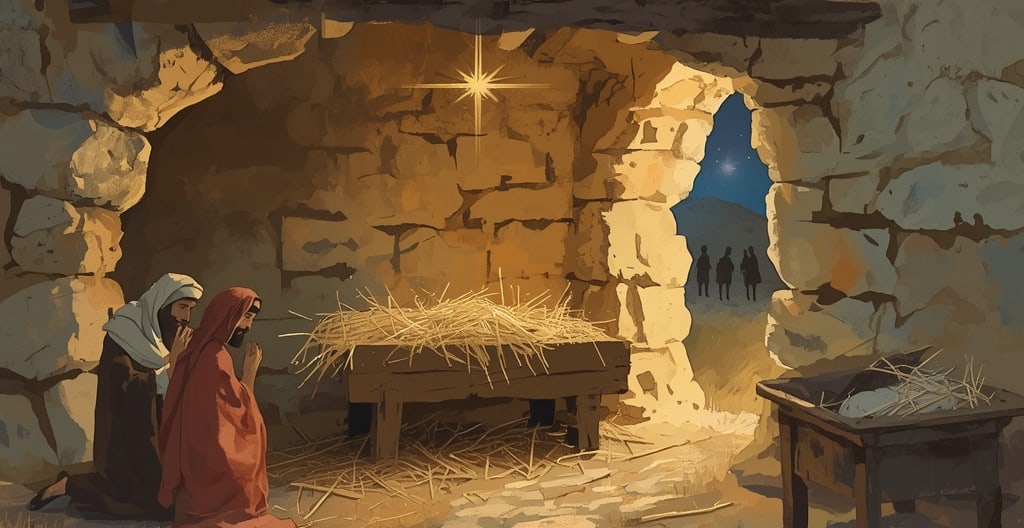
A child is born in Bethlehem (Luke 2:1 to 20). Because the Roman emperor orders everyone to register in their ancestral town, Joseph and Mary have to travel to Bethlehem, David's town, and the child is born there, in a place with no room, laid in a feeding trough for animals. No palace, no ceremony. The king the world had waited a thousand years for is born poor.
And the first people to hear the news are not kings or priests but shepherds out in the fields at night, people society regarded as low and unclean. An angel tells them that today, in David's town, a Savior has been born, who is Christ the Lord, and that this is good news for everyone (verses 10 to 11). The shepherds hurry to see, and find the child exactly as they were told.
Joseph and the name Immanuel (Matthew 1:18 to 25). Matthew tells the story from Joseph's side. When he learns Mary is pregnant, he intends to break off the engagement quietly. But an angel tells him in a dream that the child is from the Holy Spirit, and that he is to name him Jesus, because he will save his people from their sins. Then Matthew pauses the story and turns to the reader: all of this happened to fulfill what Isaiah said about the virgin who would have a child, and the child being named Immanuel, "God with us" (verses 22 to 23; compare Isaiah 7:14 from the last lesson).
John tells the same story from heaven's side (John 1:1 to 14). Luke and Matthew tell what happened on earth. John steps back to before the world existed. He begins with the same words as Genesis 1:1, "In the beginning," and says that the Word was with God then, and the Word was God. Everything was made through the Word (remember how in Genesis 1 God made everything by speaking). Then verse 14 says what no one would have expected: the Word became human, and lived among us.
Put simply: the one who spoke the world into being was born as a baby in a feeding trough. That child is not merely a good man God sent. Not an angel. Not a god temporarily taking a form. He is God himself, truly become human: with a body, hungry, tired, weeping, and able to die. And the words "lived among us" in the original language are the same word as pitching a tent, the tabernacle. The God who once lived behind a curtain in a tent now lives in the body of a person we can touch.
The Lamb of God (John 1:29). About thirty years later, John the Baptist (a different John from the one who wrote this book) sees Jesus walking toward him and announces that this is the Lamb of God who takes away the sin of the world. Your Bible uses the word พระเมษโปดก. Everyone who heard it that day thought at once of the Passover lamb.
How this points to Jesus
This lesson does not point to Jesus. This lesson is Jesus. But look at how every path we have walked meets here.
- Born of a woman, as in the first promise of Genesis 3:15, which said the one who would crush the serpent's head would be the offspring of the woman, with no mention of a man at all, which was very strange for that time. Jesus was born of Mary with no human father.
- Born of a virgin, and named Immanuel, as in Isaiah 7:14, which we read in the last lesson.
- Born in David's line, to reign forever, as promised in 2 Samuel 7. The angel used the very same words to Mary.
- Born in Bethlehem. The prophet Micah had said seven hundred years earlier that Israel's ruler would come from a small town called Bethlehem (Micah 5:2). Joseph and Mary did not live there, but the emperor's decree brought them there just in time.
- The Lamb of God. This title gathers every earlier lesson into one word: the clothes of skin, Abraham's ram, the Passover lamb, the goat on the Day of Atonement, the silent lamb of Isaiah 53. All of it points to the child in the feeding trough. This child was born to die, and to rise again.
Words to know
The word พระวาทะ, "the Word," which you meet in John 1, means a saying or speech. It is a name for Jesus before he was born as a human being. Why that name? Because words are how a person shows their thoughts and themselves to others. Jesus is how God shows himself to us so that we can know him. John 1:18 says no one has ever seen God, but the Son has made him known.
The word ประสูติ is royal register for "was born." Your Bible uses it of Jesus.
The word angel (ทูตสวรรค์) means a being God created to serve him and bring his messages to people. Not a deity people pray to for favors, and not a dead person turned spirit. Angels in the Bible usually open with the words "do not be afraid," and they always point to God, never to themselves.
The idea that Jesus is God and human at the same time, and that the one God is Father, Son, and Holy Spirit, is something Christians themselves spend a lifetime coming to understand. There is no hurry. If you have questions, ask in the question box below, or ask the person walking through this with you.
Reflect
- God chose shepherds to hear the news before anyone else, not kings or priests. Why do you think that was, and what does it say to you?
- Mary said yes knowing she would be misunderstood and might lose everything. What makes a person able to trust God that much?
- John says the maker of the world became a human being. If that is true, how does it change your idea of what God is like?
Pray
"God, I never imagined you would come this close: born as a baby in a feeding trough, to be with someone like me. If Jesus really is you, let me come to know you through Jesus. Amen."